基于“图”的算法训练
“图”的基本功训练
邻接矩阵的数据结构定义
1
2
3
4
5
6
7
8
9
10
11
12
13
14
15
16
17
18
19
20
21
22
| #define MAXV 6
typedef struct {
int numVertices, numEdges;
char VerticesList[MAXV];
int edge[MAXV][MAXV];
} MGraph;
MGraph* createMGraph(){
MGraph *graph = (MGraph*)malloc(sizeof(MGraph));
for(int i = 0; i < MAXV; i++)
for(int j = 0; j < MAXV; j++)
graph->edge[i][j] = 0;
graph->numEdges = 1;
graph->numVertices = 2;
graph->VerticesList[0] = 'a';
graph->VerticesList[1] = 'b';
graph->edge[0][1] = 1;
return graph;
}
|
邻接表的数据结构定义
1
2
3
4
5
6
7
8
9
10
11
12
13
14
15
16
17
18
19
20
21
22
23
24
25
26
27
28
29
30
31
32
33
34
35
36
37
38
39
40
41
42
43
44
45
46
47
| #define MAXV 6
typedef struct EdgeNode {
int index;
struct EdgeNode *next;
int weight;
} EdgeNode;
typedef struct VertexNode {
char data;
EdgeNode *first;
} VertexNode, VertexList[MAXV];
typedef struct ALgraph {
VertexList list;
int numVertex, numEdge;
} ALgraph;
void add(ALgraph* graph,int a, int b, int weight){
EdgeNode* edge = (EdgeNode*)malloc(sizeof(EdgeNode));
edge->index = b;
edge->weight = weight;
edge->next = graph->list[a].first;
graph->list[a].first = edge;
}
ALgraph* createMGraph(){
ALgraph *graph = (ALgraph*)malloc(sizeof(ALgraph));
for(int i = 0; i < MAXV; i++)
{
graph->list[i].first = NULL;
}
graph->numEdge = 1;
graph->numVertex = 2;
graph->list[0].data = 'a';
graph->list[0].data = 'b';
add(graph,0,1,1);
return graph;
}
|
“图”的真题训练
2021
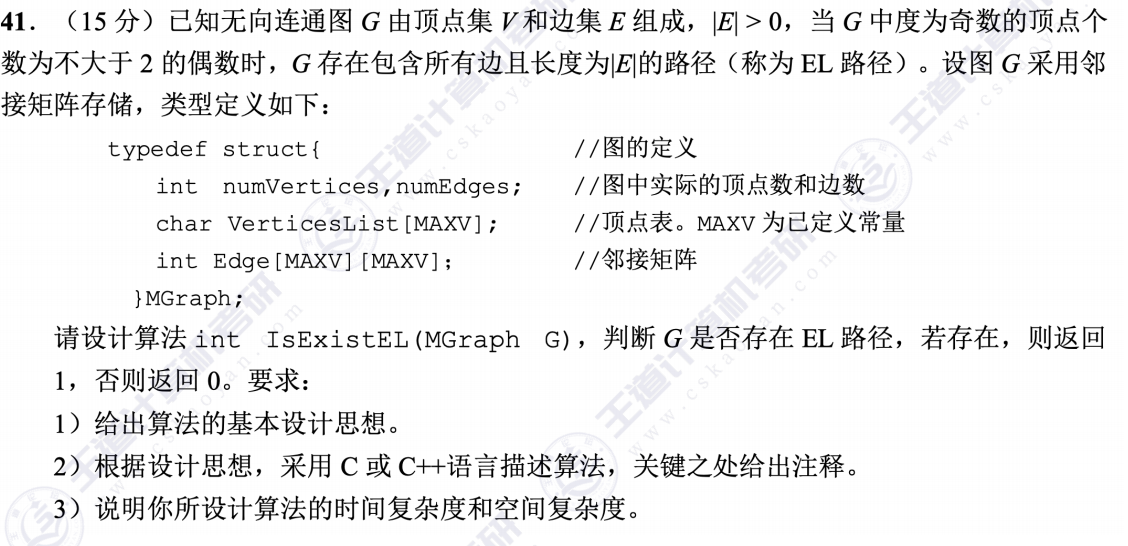
1.设计思想
由题意知度为奇数的顶点个数只能为2个或0个,由于G是无向连通图,因此第i行非0元素的个数就是该顶点的度。
统计度为奇数的顶点,不为0或2返回0。若是的话返回1。
2.代码
1
2
3
4
5
6
7
8
9
10
11
12
13
14
15
16
17
18
19
20
21
22
23
24
25
26
27
| #define MAXV 10
typedef struct{
int numVertices,numEdges;
char VerticesList[MAXV];
int Edge[MAXV][MAXV];
}MGraph;
int IsExistEL(MGraph G){
int cnt = 0;
int V = G.numVertices;
for(int i = 0; i < V; i++)
{
int tt = 0;
for(int j = 0; j < V; j++)
{
if(G.Edge[i][j]!=0)
tt++;
}
if(tt%2!=0)
cnt++;
}
if(cnt == 2 || cnt == 0)
return 1;
else
return 0;
}
|
3.复杂度
时间复杂度O(V^2),空间复杂度O(1)
4.改进
2023
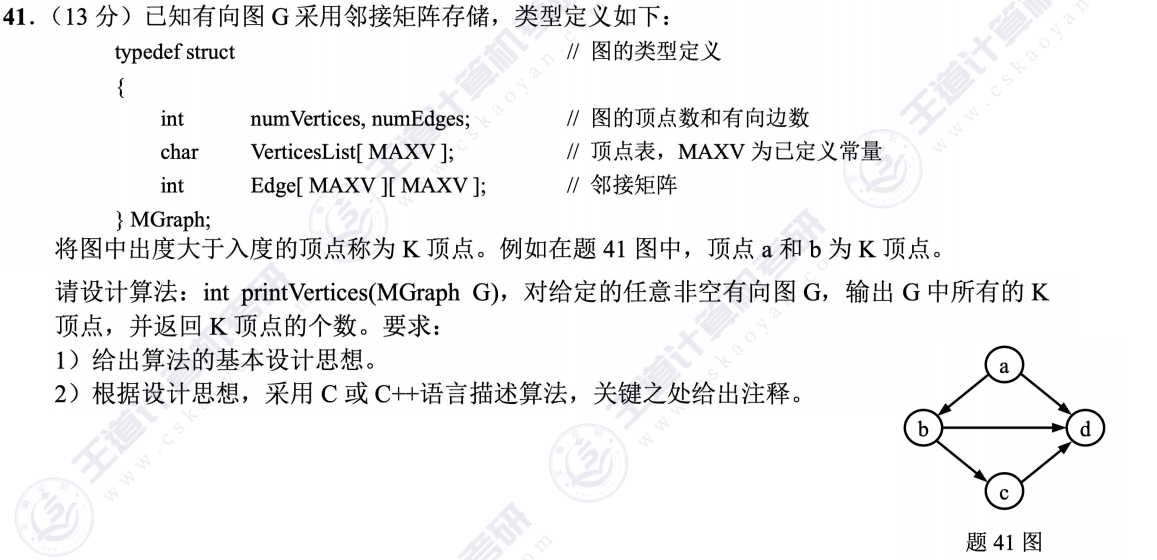
1.设计思想
由于G是有向图,因此第i行存放的是顶点i的出度,第i列存放的是顶点的入度。
若出度大于入度,则输出顶点并计数。否则遍历下一顶点。
2.代码
1
2
3
4
5
6
7
8
9
10
11
12
13
14
15
16
17
18
19
20
21
22
23
24
25
26
27
28
29
30
31
32
33
34
35
36
37
| #define MAXV 10
typedef struct{
int numVertices,numEdges;
char VerticesList[MAXV];
int Edge[MAXV][MAXV];
}MGraph;
int printVertices(MGraph G)
{
int kcnt = 0;
int v = G.numVertices;
for(int i = 0; i < v; i++)
{
int indegree = 0,outdegree = 0;
for(int j = 0; j < v; j++)
{
if(G.Edge[i][j]!=0)
{
outdegree++;
}
}
for(int j = 0; j < v; j++)
{
if(G.Edge[j][i]!=0)
{
indegree++;
}
}
if(outdegree>indegree)
{
kcnt++;
printf("%c ",G.VerticesList[i]);
}
}
return kcnt;
}
|
3.复杂度
O(v^2),空间复杂度O(1)
4.改进
等价:
1
2
3
4
| degree += G.Edge[i][j];
if(G.Edge[i][j] != 0) {
degree++;
}
|