于“树和二叉树”的算法训练 二叉树的基本功训练 1. 二叉树的前、中、后序遍历 1 2 3 4 5 6 7 8 9 10 11 12 13 14 15 16 17 18 19 20 21 22 23 24 25 26 27 28 29 30 31 32 33 34 35 36 37 38 39 40 41 42 43 44 45 46 47 48 49 50 51 52 53 54 55 56 57 58 59 60 61 62 63 64 typedef struct BiTNode { int data; struct BiTNode *lchild,*rchild; }BiTNode, *BiTree; void visit (BiTree root) printf ("%d " ,root->data); } void PreOrder (BiTree root) if (root == NULL ) return ; visit (root); PreOrder (root->lchild); PreOrder (root->rchild); } void InOrder (BiTree root) if (root == NULL ) return ; InOrder (root->lchild); visit (root); InOrder (root->rchild); } void PostOrder (BiTree root) if (root == NULL ) return ; PostOrder (root->lchild); PostOrder (root->rchild); visit (root); } void FreeTree (BiTree root) if (root == NULL ) return ; FreeTree (root->lchild); FreeTree (root->rchild); free (root); } BiTree CreateNode (int data) { BiTree node = (BiTree)malloc (sizeof (BiTNode)); node->data = data; node->lchild = node->rchild = NULL ; return node; } int main () BiTree root = CreateNode (1 ); root->data = 1 ; root->lchild = CreateNode (2 ); root->rchild = CreateNode (3 ); PreOrder (root); printf ("\n" ); InOrder (root); printf ("\n" ); PostOrder (root); printf ("\n" ); FreeTree (root); }
2.二叉树的层序遍历 需要自己实现队列
TODO:实现链队列
1 2 3 4 5 6 7 8 9 10 11 12 13 14 15 16 17 18 19 20 21 22 23 24 25 26 27 28 29 30 31 32 33 34 35 36 37 38 39 40 41 42 43 44 45 46 47 48 49 50 51 52 53 54 55 56 57 58 59 60 61 62 63 64 65 66 67 68 69 70 71 72 73 74 75 76 77 78 79 80 81 82 83 84 85 86 87 88 89 90 91 92 93 94 95 96 97 98 99 100 101 102 103 104 105 #define MAX_QUEUE 10 typedef struct BiTNode { int data; struct BiTNode *lchild,*rchild; }BiTNode, *BiTree; typedef struct Queue { BiTree data[MAX_QUEUE]; int front; int rear; }Queue, *QueuePtr; QueuePtr InitQueue () QueuePtr Q = (QueuePtr)malloc (sizeof (Queue)); Q->front = 0 ; Q->rear = 0 ; return Q; } void FreeQueue (QueuePtr Q) free (Q); } bool isEmpty (QueuePtr Q) if (Q->front == Q->rear) return true ; else return false ; } bool isFull (QueuePtr Q) if ((Q->rear+1 ) % MAX_QUEUE == Q->front) return true ; else return false ; } bool EnQueue (QueuePtr Q, BiTree node) if (isFull (Q)) return false ; Q->data[Q->rear] = node; Q->rear = (Q->rear+1 )%MAX_QUEUE; return true ; } BiTree DeQueue (QueuePtr Q) if (isEmpty (Q)) return NULL ; BiTree q; q = Q->data[Q->front]; Q->front = (Q->front+1 )%MAX_QUEUE; return q; } void visit (BiTree root) printf ("%d " ,root->data); } void LevelOrder (BiTree root) QueuePtr Q = InitQueue (); EnQueue (Q, root); while (!isEmpty (Q)) { BiTree nod = DeQueue (Q); visit (nod); if (nod->lchild!=NULL ) EnQueue (Q, nod->lchild); if (nod->rchild!=NULL ) EnQueue (Q, nod->rchild); } FreeQueue (Q); } BiTree CreateNode (int data) { BiTree node = (BiTree)malloc (sizeof (BiTNode)); node->data = data; node->lchild = node->rchild = NULL ; return node; } void FreeTree (BiTree root) if (root == NULL ) return ; FreeTree (root->lchild); FreeTree (root->rchild); free (root); } int main () BiTree root = CreateNode (1 ); root->data = 1 ; root->lchild = CreateNode (2 ); root->rchild = CreateNode (3 ); LevelOrder (root); FreeTree (root); }
3.求二叉树的高度
用全局变量
用递归返回,后序遍历 ,从树底部计算到树顶。
1 2 3 4 5 6 7 8 9 10 11 12 13 14 15 16 17 18 19 20 21 22 23 24 25 26 27 28 29 30 31 32 33 34 35 36 37 38 39 40 41 42 43 44 45 46 47 48 49 50 51 52 53 54 55 56 57 58 59 60 61 typedef struct BiTNode { int data; struct BiTNode *lchild,*rchild; }BiTNode, *BiTree; void visit (BiTree root) printf ("%d " ,root->data); } BiTree CreateNode (int data) { BiTree node = (BiTree)malloc (sizeof (BiTNode)); node->data = data; node->lchild = node->rchild = NULL ; return node; } void FreeTree (BiTree root) if (root == NULL ) return ; FreeTree (root->lchild); FreeTree (root->rchild); free (root); } int height = 0 ;void GetHegiht1 (BiTree root, int h) if (root==NULL ) return ; if (h>height) height = h; GetHegiht1 (root->lchild, h+1 ); GetHegiht1 (root->rchild, h+1 ); } int GetHegiht2 (BiTree root) if (root==NULL ) return 0 ; int l = GetHegiht2 (root->lchild); int r = GetHegiht2 (root->rchild); if (l>=r) return l+1 ; else return r+1 ; } int main () BiTree root = CreateNode (1 ); root->data = 1 ; root->lchild = CreateNode (2 ); root->rchild = CreateNode (3 ); root->lchild->lchild = CreateNode (4 ); root->lchild->lchild->rchild = CreateNode (5 ); GetHegiht1 (root, 1 ); printf ("%d\n" ,height); printf ("%d\n" ,GetHegiht2 (root)); FreeTree (root); }
4.求二叉树宽度 用前序遍历 使得二叉树从上到下被访问。
1 2 3 4 5 6 7 8 9 10 11 12 13 14 15 16 17 18 19 20 21 22 23 24 25 26 27 28 29 30 31 32 33 34 35 36 37 38 39 40 41 42 43 44 45 46 47 48 49 50 51 52 53 54 55 56 57 58 59 60 61 62 63 64 65 66 #define MAXHEIGH 10 int Width[MAXHEIGH];typedef struct BiTNode { int data; struct BiTNode *lchild,*rchild; }BiTNode, *BiTree; void visit (BiTree root) printf ("%d " ,root->data); } BiTree CreateNode (int data) { BiTree node = (BiTree)malloc (sizeof (BiTNode)); node->data = data; node->lchild = node->rchild = NULL ; return node; } void FreeTree (BiTree root) if (root == NULL ) return ; FreeTree (root->lchild); FreeTree (root->rchild); free (root); } void PreOrder (BiTree root,int level) if (root==NULL ) return ; Width[level]++; PreOrder (root->lchild, level + 1 ); PreOrder (root->rchild, level + 1 ); } int GetWidth (BiTree root) if (root == NULL ) return 0 ; for (int i = 0 ; i < MAXHEIGH; i++) { Width[i] = 0 ; } PreOrder (root,0 ); int maxwidth = 0 ; for (int i = 0 ;i < MAXHEIGH; i++) { if (Width[i]>maxwidth) maxwidth = Width[i]; } return maxwidth; } int main () BiTree root = CreateNode (1 ); root->data = 1 ; root->lchild = CreateNode (2 ); root->rchild = CreateNode (3 ); root->lchild->lchild = CreateNode (4 ); root->lchild->rchild = CreateNode (5 ); root->rchild->lchild = CreateNode (6 ); root->rchild->rchild = CreateNode (7 ); printf ("%d" ,GetWidth (root)); FreeTree (root); }
5.求二叉树的WPL WPL:二叉树中所有叶子节点 的权值 与其到根节点路径长度 的乘积之和。
WPL 仅计算叶子节点,且深度从 0 开始计数 。
处理方法类似求树的高度,只不过我们需要在叶子节点处特判求WPL
使用全局变量WPL
递归计算
1 2 3 4 5 6 7 8 9 10 11 12 13 14 15 16 17 18 19 20 21 22 23 24 25 26 27 28 29 30 31 32 33 34 35 36 37 38 39 40 41 42 43 44 45 46 47 48 49 50 51 52 53 54 55 typedef struct BiTNode { int weight; struct BiTNode *lchild,*rchild; }BiTNode, *BiTree; BiTree CreateNode (int weight) { BiTree node = (BiTree)malloc (sizeof (BiTNode)); node->weight = weight; node->lchild = node->rchild = NULL ; return node; } void FreeTree (BiTree root) if (root == NULL ) return ; FreeTree (root->lchild); FreeTree (root->rchild); free (root); } int WPL = 0 ;void GetWeight (BiTree root,int level) if (root==NULL ) return ; if (root->lchild == NULL && root->rchild == NULL ) WPL += root->weight * level; GetWeight (root->lchild, level + 1 ); GetWeight (root->rchild, level + 1 ); } int GetWeight2 (BiTree root, int level) if (root==NULL ) return 0 ; if (root->lchild == NULL && root->rchild == NULL ) return root->weight * level; return GetWeight2 (root->lchild, level+1 ) + GetWeight2 (root->rchild, level+1 ); } int main () BiTree root = CreateNode (1 ); root->weight = 1 ; root->lchild = CreateNode (2 ); root->rchild = CreateNode (3 ); root->lchild->lchild = CreateNode (4 ); root->lchild->rchild = CreateNode (5 ); root->rchild->lchild = CreateNode (6 ); root->rchild->rchild = CreateNode (7 ); GetWeight (root, 0 ); printf ("%d\n" ,WPL); printf ("%d\n" ,GetWeight2 (root,0 )); FreeTree (root); }
6.判定一棵二叉树是否为二叉排序树 二叉排序树定义:
左节点值 < 根节点值 < 右节点值
空树
直接使用中序遍历实现
1 2 3 4 5 6 7 8 9 10 11 12 13 14 15 16 17 18 19 20 21 22 23 24 25 26 27 28 29 30 31 32 33 34 35 36 37 38 39 40 41 42 43 44 45 46 typedef struct BiTNode { int data; struct BiTNode *lchild,*rchild; }BiTNode, *BiTree; BiTree CreateNode (int data) { BiTree node = (BiTree)malloc (sizeof (BiTNode)); node->data = data; node->lchild = node->rchild = NULL ; return node; } void FreeTree (BiTree root) if (root == NULL ) return ; FreeTree (root->lchild); FreeTree (root->rchild); free (root); } int tmp = -111111 ;bool is_BST = true ;void inorder (BiTree root) if (root == NULL ) return ; inorder (root->lchild); if (tmp <= root->data) tmp =root->data; else is_BST = false ; inorder (root->rchild); } int main () BiTree root = CreateNode (1 ); root->data = 1 ; root->lchild = CreateNode (2 ); root->rchild = CreateNode (3 ); root->lchild->lchild = CreateNode (4 ); root->lchild->rchild = CreateNode (5 ); root->rchild->lchild = CreateNode (6 ); root->rchild->rchild = CreateNode (7 ); inorder (root); printf ("%d" ,is_BST); FreeTree (root); }
7.判定一棵二叉树是否平衡 后序遍历,从叶节点开始判断左右子树是否平衡
1 2 3 4 5 6 7 8 9 10 11 12 13 14 15 16 17 18 19 20 21 22 23 24 25 26 27 28 29 30 31 32 33 34 35 36 37 38 39 40 41 42 43 44 45 46 47 48 49 50 51 52 53 typedef struct BiTNode { int data; struct BiTNode *lchild,*rchild; }BiTNode, *BiTree; BiTree CreateNode (int data) { BiTree node = (BiTree)malloc (sizeof (BiTNode)); node->data = data; node->lchild = node->rchild = NULL ; return node; } void FreeTree (BiTree root) if (root == NULL ) return ; FreeTree (root->lchild); FreeTree (root->rchild); free (root); } int abs_ (int x) return x>0 ?x:-x; } int postorder (BiTree node,bool * is_balance) if (node == NULL ) return 0 ; int l = postorder (node->lchild,is_balance) ; int r = postorder (node->rchild,is_balance) ; if (abs_ (r-l) > 1 ) *is_balance = false ; return (l>r ? l:r)+1 ; } bool is_balance (BiTree node) bool is_balance = true ; postorder (node, &is_balance); return is_balance; } int main () BiTree root = CreateNode (1 ); root->lchild = CreateNode (2 ); root->rchild = CreateNode (3 ); root->lchild->lchild = CreateNode (4 ); root->lchild->rchild = CreateNode (5 ); root->rchild->lchild = CreateNode (6 ); root->rchild->rchild = CreateNode (7 ); printf ("%d" ,is_balance (root)); FreeTree (root); }
8.判定一棵二叉树是否为完全二叉树。
采用层序遍历
注意队列需要头指针和尾指针,队尾方便插入,队首方便删除。
讨论左右孩子存不存在的四种情况
1 2 3 4 5 6 7 8 9 10 11 12 13 14 15 16 17 18 19 20 21 22 23 24 25 26 27 28 29 30 31 32 33 34 35 36 37 38 39 40 41 42 43 44 45 46 47 48 49 50 51 52 53 54 55 56 57 58 59 60 61 62 63 64 65 66 67 68 69 70 71 72 73 74 75 76 77 78 79 80 81 82 83 84 85 86 87 88 89 90 91 92 93 94 95 96 97 98 99 100 101 102 103 104 105 106 107 108 109 110 111 112 113 114 115 116 117 118 119 120 121 122 123 124 125 126 127 128 129 130 131 132 133 134 135 136 137 138 139 140 141 142 143 144 145 146 147 148 149 150 151 152 153 154 155 156 157 158 159 typedef struct BiTNode { int data; struct BiTNode *lchild,*rchild; }BiTNode, *BiTree; typedef struct QueueNode { BiTree data; struct QueueNode *next; }QueueNode, *QueueNodePtr; typedef struct LinkQueue { QueueNode *front; QueueNode *tail; }LinkQueue, *LinkQueuePtr; LinkQueuePtr InitQueue () { LinkQueuePtr p = (LinkQueuePtr)malloc (sizeof (LinkQueue)); QueueNodePtr head = (QueueNodePtr)malloc (sizeof (QueueNode)); head->next = NULL ; head->data = NULL ; p->front = p->tail = head; return p; } bool is_empty (LinkQueuePtr link) return link->front == link->tail; } void EnQueue (LinkQueuePtr link, BiTree node) QueueNodePtr q = (QueueNodePtr)malloc (sizeof (QueueNode)); q->data = node; q->next = NULL ; link->tail->next = q; link->tail = q; } BiTree DeQueue (LinkQueuePtr link) { if (is_empty (link)) { return NULL ; } QueueNodePtr q = link->front->next; BiTree data = q->data; link->front->next = q->next; if (q == link->tail) { link->tail = link->front; } free (q); return data; } void DestroyQueue (LinkQueuePtr link) while (!is_empty (link)) { DeQueue (link); } free (link->front); free (link); } BiTree CreateNode (int data) { BiTree node = (BiTree)malloc (sizeof (BiTNode)); node->data = data; node->lchild = node->rchild = NULL ; return node; } void FreeTree (BiTree root) if (root == NULL ) return ; FreeTree (root->lchild); FreeTree (root->rchild); free (root); } void judge (BiTree root, bool * is_complete_tree, bool * flag) if (root->lchild == NULL && root->rchild == NULL ) *flag = true ; if (root->lchild == NULL && root->rchild != NULL ) *is_complete_tree = false ; if (root->lchild != NULL && root->rchild == NULL ) { if (*flag) *is_complete_tree = false ; *flag = true ; } if (root->lchild != NULL && root->rchild != NULL ) { if (*flag) *is_complete_tree = false ; } } bool is_complete_tree (BiTree root) LinkQueuePtr qu = InitQueue (); EnQueue (qu, root); bool is_complete_tree = true ; bool flag = 0 ; while (!is_empty (qu)) { BiTree node = DeQueue (qu); judge (node, & is_complete_tree, &flag); if (node->lchild != NULL ) EnQueue (qu, node->lchild); if (node->rchild != NULL ) EnQueue (qu, node->rchild); } return is_complete_tree; } int main () BiTree root1 = CreateNode (1 ); root1->lchild = CreateNode (2 ); root1->rchild = CreateNode (3 ); root1->lchild->lchild = CreateNode (4 ); root1->lchild->rchild = CreateNode (5 ); root1->rchild->lchild = CreateNode (6 ); root1->rchild->rchild = CreateNode (7 ); printf ("测试1(完全二叉树): %d\n" , is_complete_tree (root1)); FreeTree (root1); BiTree root2 = CreateNode (1 ); root2->lchild = CreateNode (2 ); root2->rchild = CreateNode (3 ); root2->lchild->lchild = CreateNode (4 ); root2->rchild->rchild = CreateNode (5 ); printf ("测试2(非完全二叉树): %d\n" , is_complete_tree (root2)); FreeTree (root2); BiTree root3 = CreateNode (1 ); root3->lchild = CreateNode (2 ); root3->rchild = CreateNode (3 ); root3->lchild->rchild = CreateNode (4 ); printf ("测试3(非完全二叉树): %d\n" , is_complete_tree (root3)); FreeTree (root3); return 0 ; }
9.跨考基本训练1 比8更简便的判断方法,将所有非空节点都入队(顺序从左到右,从上到下),当遇到空节点后,检查队列中剩余节点是否全为空。
1 2 3 4 5 6 7 8 9 10 11 12 13 14 15 16 17 18 19 20 21 22 23 24 bool is_complete_tree (BiTree root) LinkQueuePtr qu = InitQueue (); if (root == NULL ) return true ; EnQueue (qu, root); while (!is_empty (qu)) { BiTree node = DeQueue (qu); if (node!=NULL ) { EnQueue (qu, node->lchild); EnQueue (qu, node->rchild); } else { while (!is_empty (qu)) { BiTree node1 = DeQueue (qu); if (node1!=NULL ) return false ; } } } return true ; }
10.跨考基本训练2 用后序遍历实现递归从子树开始计算双分支节点个数
1 2 3 4 5 6 7 8 9 10 11 12 13 14 15 16 17 18 19 20 21 22 23 24 25 26 27 28 29 30 31 32 33 34 35 36 37 38 39 40 41 42 43 44 45 46 47 typedef struct BiTNode { int data; struct BiTNode *lchild,*rchild; }BiTNode, *BiTree; BiTree CreateNode (int data) { BiTree node = (BiTree)malloc (sizeof (BiTNode)); node->data = data; node->lchild = node->rchild = NULL ; return node; } void FreeTree (BiTree root) if (root == NULL ) return ; FreeTree (root->lchild); FreeTree (root->rchild); free (root); } int Get2branchnode (BiTree root) if (root == NULL ) return 0 ; int l = Get2branchnode (root->lchild); int r = Get2branchnode (root->rchild); if (root->lchild != NULL && root->rchild != NULL ) { return l + r + 1 ; } else { return l + r; } } int main () BiTree root = CreateNode (1 ); root->data = 1 ; root->lchild = CreateNode (2 ); root->rchild = CreateNode (3 ); root->lchild->lchild = CreateNode (4 ); root->lchild->lchild->lchild = CreateNode (5 ); root->lchild->lchild->rchild = CreateNode (6 ); printf ("%d" ,Get2branchnode (root)); FreeTree (root); }
11.跨考基本训练3 1 2 3 4 5 6 7 8 9 10 11 12 13 14 15 16 17 18 19 20 21 22 23 24 25 26 27 28 29 30 31 32 33 34 35 36 37 38 39 40 41 42 43 44 45 46 47 48 typedef struct BiTNode { int data; struct BiTNode *lchild,*rchild; }BiTNode, *BiTree; BiTree CreateNode (int data) { BiTree node = (BiTree)malloc (sizeof (BiTNode)); node->data = data; node->lchild = node->rchild = NULL ; return node; } void FreeTree (BiTree root) if (root == NULL ) return ; FreeTree (root->lchild); FreeTree (root->rchild); free (root); } void PreOrderKth (BiTree root, int k, int &count, int &result) if (root == NULL || result != -1 ) return ; count++; if (count == k) { result = root->data; return ; } PreOrderKth (root->lchild, k, count, result); PreOrderKth (root->rchild, k, count, result); } int main () BiTree root = CreateNode (1 ); root->data = 1 ; root->lchild = CreateNode (2 ); root->rchild = CreateNode (3 ); root->lchild->lchild = CreateNode (4 ); root->lchild->lchild->lchild = CreateNode (5 ); root->lchild->lchild->rchild = CreateNode (6 ); int result = -1 ; int count = 0 ; PreOrderKth (root,4 ,count,result); printf ("%d" ,result); FreeTree (root); }
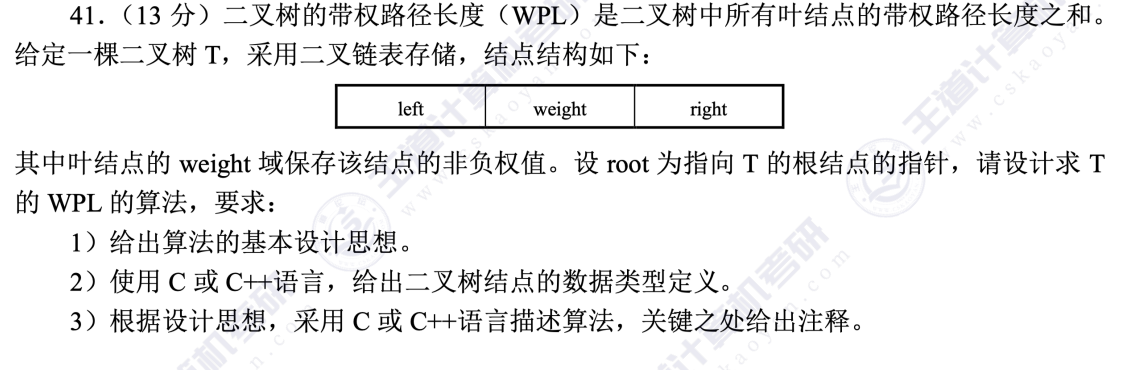
“二叉树”的真题训练 2014 1.设计思想
先序遍历,在遍历的同时记录节点当前的深度。
若该节点左右节点为空,即为叶子节点,计算其带权路径长度
若该节点左右节点非空,递归访问左右节点计算带权路径长度
节点为空,直接返回。
2.代码 1 2 3 4 5 6 7 8 9 10 11 12 13 14 15 16 17 18 19 20 21 22 23 24 25 26 27 28 29 30 31 32 33 34 35 36 37 typedef struct BitNode { int weight; struct BitNode *left,*right; }BitNode, *BiTree; BiTree CreateNode (int data) { BiTree node = (BiTree)malloc (sizeof (BitNode)); node->weight = data; node->left= node->right = NULL ; return node; } void FreeTree (BiTree root) if (root == NULL ) return ; FreeTree (root->left); FreeTree (root->right); free (root); } int GetWPL (BiTree node, int dep) if (node == NULL ) return 0 ; if (node->left == NULL && node->right == NULL ) return node->weight*dep; return GetWPL (node->left, dep+1 ) + GetWPL (node->right, dep+1 ); } int main () BiTree root = CreateNode (1 ); root->weight = 1 ; root->left = CreateNode (2 ); root->right = CreateNode (3 ); root->left->left = CreateNode (4 ); root->left->right = CreateNode (5 ); root->right->left = CreateNode (6 ); root->right->right = CreateNode (7 ); printf ("%d" ,GetWPL (root, 0 )); }
3.复杂度 时间复杂度O(n),空间复杂度O(n)
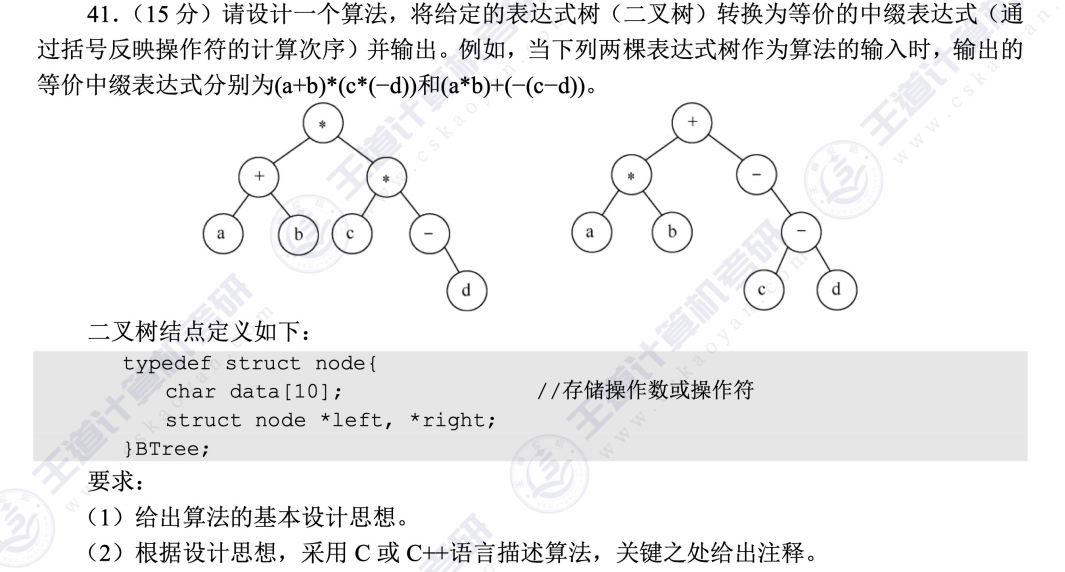
4.改进 2017 1.设计思想 通过中序遍历实现,遍历表达式二叉树,将符号节点与其左子树和右子树结合起来
由于根节点回引入额外的括号,因此我们需要使用dep避免输出额外括号
2.代码 1 2 3 4 5 6 7 8 9 10 11 12 13 14 15 16 17 18 19 20 21 22 23 24 25 26 27 28 29 30 31 32 33 34 35 36 37 38 39 40 41 42 43 44 45 46 47 48 49 50 51 52 53 54 55 56 57 58 59 60 61 62 63 64 65 66 67 68 69 70 71 72 73 74 75 76 77 78 79 80 81 82 83 84 85 86 87 88 89 90 91 92 93 94 95 96 97 98 99 100 typedef struct node { char data[10 ]; struct node *left, *right; }BTree; BTree* CreateNode (const char data[10 ]) { BTree *node = (BTree*)malloc (sizeof (BTree)); strcpy (node->data, data); node->left= node->right = NULL ; return node; } void FreeTree (BTree* root) if (root == NULL ) return ; FreeTree (root->left); FreeTree (root->right); free (root); } void GetOpt (BTree* node,int dep) if (node==NULL ) return ; if (node->left != NULL || node->right != NULL ) { if (dep!=0 ) printf ("(" ); GetOpt (node->left,dep+1 ); printf ("%s" ,node->data) ; GetOpt (node->right,dep+1 ); if (dep!=0 ) printf (")" ); } else { printf ("%s" ,node->data); } } BTree* CreateExpressionTree1 () { BTree* multiply1 = CreateNode ("*" ); BTree* plus = CreateNode ("+" ); BTree* multiply2 = CreateNode ("*" ); BTree* a = CreateNode ("a" ); BTree* b = CreateNode ("b" ); BTree* c = CreateNode ("c" ); BTree* minus1 = CreateNode ("-" ); BTree* d = CreateNode ("d" ); multiply1->left = plus; multiply1->right = multiply2; plus->left = a; plus->right = b; multiply2->left = c; multiply2->right = minus1; minus1->right = d; return multiply1; } BTree* CreateExpressionTree2 () { BTree* plus = CreateNode ("+" ); BTree* multiply = CreateNode ("*" ); BTree* minus1 = CreateNode ("-" ); BTree* a = CreateNode ("a" ); BTree* b = CreateNode ("b" ); BTree* minus2 = CreateNode ("-" ); BTree* c = CreateNode ("c" ); BTree* d = CreateNode ("d" ); plus->left = multiply; plus->right = minus1; multiply->left = a; multiply->right = b; minus1->left = NULL ; minus1->right = minus2; minus2->left = c; minus2->right = d; return plus; } int main () BTree* root1 = CreateExpressionTree1 (); GetOpt (root1,0 ); cout << endl; FreeTree (root1); BTree* root2 = CreateExpressionTree2 (); GetOpt (root2,0 ); cout << endl; FreeTree (root2); return 0 ; }
3.复杂度 时间复杂度O(n),空间复杂度O(n)
4.改进 2022 1.设计思想
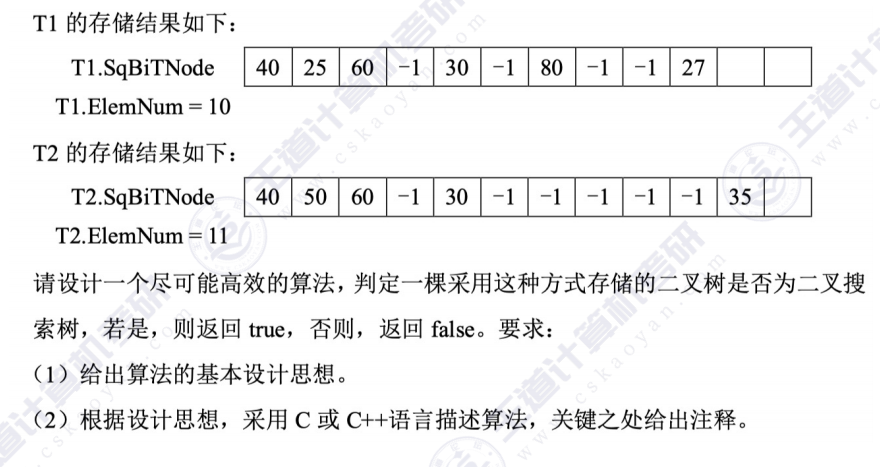
二叉搜索树的关键特性是其中序遍历序列为一个严格递增的序列。
采用中序遍历判断二叉树的节点值是否为递增的,由于非空二叉树的节点值为正数,可以使用变量min-1作为初值判断是否为二叉排序树。
左孩子2i,右孩子2i+1,父节点【i/2】下取整
2.代码 1 2 3 4 5 6 7 8 9 10 11 12 13 14 15 16 17 18 19 20 21 22 23 24 25 26 27 28 29 30 31 32 33 34 35 36 37 38 39 40 typedef struct { int SqBiTNode[MAX_SIZE]; int ElemNum; }SqBiTree; int min_num = -1 ;bool flag = true ;void judge (SqBiTree *T, int pos) if (pos >= T->ElemNum || flag == false || T->SqBiTNode[pos-1 ]==-1 ) return ; judge (T,2 *pos); if (T->SqBiTNode[pos-1 ] >= min_num) { min_num = T->SqBiTNode[pos-1 ]; } else { flag = false ; return ; } judge (T,2 *pos+1 ); } bool Is_Search_Tree (SqBiTree *T) flag = true ; min_num = -1 ; judge (T, 1 ); return flag; } int main () SqBiTree T1 = {{40 , 25 , 60 , -1 , 30 , -1 , 80 , -1 , -1 , 27 }, 10 }; SqBiTree T2 = {{40 , 50 , 60 , -1 , 30 , -1 , -1 , -1 , -1 , -1 , 35 }, 11 }; printf ("T1 is BST? %s\n" , Is_Search_Tree (&T1) ? "Yes" : "No" ); printf ("T2 is BST? %s\n" , Is_Search_Tree (&T2) ? "Yes" : "No" ); }
3.复杂度 时间复杂度O(n),空间复杂度O(n)
4.改进